Click this for a quick easy guide to all the Memory Work resources and information available on this website.


The Memory Book Story
Origins of the Memory Book.

Memory Store developed by Barnardos
It's hard to remember back to a world without Aids. But in the 1980s the illness and its consequences, particularly for children, just were not understood. One of the first attempts to look at the needs of children began in a small project in London in 1989. This is where ideas for the Memory Book were first developed by Carol Lindsay Smith and colleagues working at Barnardo's Positive Options.* [1].
The project had been set up to help parents with HIV to make plans for the future care of their children – because at that time there were few treatments for HIV and parents feared they would die before the children were old enough to look after themselves. Many of the families who came to Positive Options originated from East and Central Africa and were now facing terminal illness far away from support of family and friends – so their greatest fear was "What will happen to my children when I die?"
Project workers realised it was urgent that parents write down all the important information that the children would need to know. But where to begin?? The original Memory Book guidelines were written to make this task manageable, to help parents think about the sort of information their children would need in order to understand their origins and re-connect with the extended family.
Why the Memory Book is needed.
Every child needs to know “Who am I? Where do I fit in?” But in many parts of the world the number of orphaned and separated children is now so great that parents can no longer rely on community elders or extended family to supply the information and continuity of care that their children need. This means that other ways of supporting children and helping them make sense of their world have had to be found.
From nearly 20 years experience of working with families in desperate circumstances, we know that the Memory Book (and related training programmes) has helped to fill in some of the gaps and provide a safety net.
We also know that for many families the process of making a Memory Book has helped parents and children to start to talk directly (and listen) to each other. This has been a step on the way towards much better understanding of what it means to be a good parent and how children can be helped towards independence.
How it works.
The first part of the Memory Book Guide explains to parents WHY it’s important to give children accurate information about themselves and their family of origin.The next section explains HOW to do it. The ideas in the booklet are so easy to understand that, even if there is no-one available to help explain the ideas, most parents or carers can manage on their own.If parents have difficulty writing, or are too ill to cope with paperwork, the whole process can be handled verbally with a helper asking trigger questions from the booklet then tape recording or writing down the answers. What matters is to capture the personal details, the emotions, hopes and fears which parents would normally share with their children over the years. Memory Book Guide Booklet is available for download on the Memory Book Guide/Languages page
Impact of using the Memory Book.
For many African families the idea of writing about the family is a natural continuation of the oral tradition which, in more settled times, helped children to gradually absorb the history, culture, beliefs and rules of their community through story telling and listening to adults talk. In fact parents and carers from many different cultures have found the Memory Book ideas easy to accept and adapt to their own family circumstances. They have welcomed the chance to record factual information about the family history, including “space” to write about themselves as real people in healthier times, so they will not be remembered just as a dying parent. But what parents have liked best is the idea that they can leave a written legacy of parental guidance and hopes for the future of their children.
For nearly every family which has made a Memory Book, it has turned out to be worth the emotional effort and use of scarce resources. It has been workable and comforting for the writer (that is the parent or person who is looking after the child) and quite outstandingly helpful for the children who receive their own memory books.
How the Memory book developed.
During the early work in the 1990s, parents attending Positive Options in London suggested different topics that they wanted to include in their Memory Books. As well as giving the facts many of them wanted to write about their beliefs and traditions and their hopes for their children’s future.
Having previously been too afraid to discuss illness and death with their children, parents now welcomed the opportunity that the Memory Book gave them to write the truth about the family situation and to provide ideas about how their children might cope in the future. So gradually Memory Books developed from being factual records into very personal systems for preparing the family to cope with severe loss, including possible death of parents, or separation from brothers and sisters and extended family.
Another idea which grew spontaneously from the wishes of the parents was the Memory Store or Memory Basket. This would provide a safe place to keep a few “treasures”, NOT valuables or legal documents, but small household or personal items which would help children to keep their memories alive.
Opening up to children.
With all this activity focused on collecting information, photos and small objects, it wasn’t long before children began to take an interest in what their parents were doing. And so, in many cases, making Memory Books and Baskets led quite naturally to parents and children starting to talk to each other about subjects which had previously been “no go” areas – sex, death, money, inheritance, paternity. In situations where children were likely to be orphaned or separated, parents even began to talk with them about plans for the future.
From the children’s side, they found a way to ask questions which had previously been out of bounds and in many cases they had the new experience of being listened to, giving their own point of view. In situations where parents were too ill or were unable to write children also became involved in collecting information and doing the actual writing. For families who made this communications breakthrough, it brought enormous benefits. Parents and children began to understand more about each other, building trust and being better prepared to cope with whatever serious problems came along.
In fact we know of cases where the situation was less devastating when a parent died because there was a PLAN - the child knew what would happen next. There is also anecdotal evidence that, when young people have had the chance to talk openly with their parents about the reality of HIV in their own family, it strengthens their determination to avoid risky behaviour.
Of course there will always be parents who find it too harrowing to talk to their children because they can’t see any way forward. But in such cases, even if they only write a few lines or set aside a few mementoes, not all is lost.
Memory Book arrives in Africa.
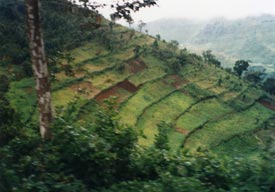
Uganda - a fertile land for ideas and crops
In 1995/6 Carol Lindsay Smith had the chance to visit Uganda where she showed the Memory Book to social worker Beatrice Were.** Beatrice, who was herself HIV+ and the mother of two young children, was one of the founders and first Co-ordinator of National Community of Women Living with HIV/AIDS.*** Beatrice quickly realised that the Memory Book ideas could help the women break down “the wall of silence” which was preventing them from talking openly to their children about Aids in the family. Before long, with help from the originators of the Memory Book, Beatrice and her colleagues were running workshops which would spread the Memory Book ideas far and wide.
Memory Book for Africa.
In 2000 eight young Ugandan mothers who had already written their own Memory Books, helped Carol Lindsay Smith to adapt the original text to be more user friendly in African countries. This version, the “Memory Book for Africa”, is available to download on this website link to download Memory Book text. It is also available as a printed booklet from TALC*****. As well as the English language version, the Memory Book has been translated into Luganda, KiSwahili, Spanish and Spanish for Latin American countries.They are all available on this website. Other languages will be added to this website as they become available.
The Memory Project training programme.
Despite limited resources for traveling and training other groups of parents who wanted to know about the Memory Book, the ideas quickly spread across Uganda and to neighbouring countries. At the same time parents were asking for more information on how to talk openly with their children, how to go public on their HIV status - a whole range of questions about parenting, making future plans and the legal process for making the plans stick.It was becoming urgent to build a training programme to cover these and related topics to help parents make progress with their new ideas on good parenting. Beatrice and her colleagues were helped to develop the training materials by a number of professional trainers in Uganda as well as the Memory Book team in the UK. But the main shape and content of the programme grew out of the courage and determination of the grass roots women who wanted to change the way they talked and listened to their children and to know how to prepare them for an uncertain future. It really was a revolution in parenting ideas which continues to have an impact today. Link to further information on the Memory Project Training Programme.
Plans to develop the Memory Project.
The spirit and the content of the original Memory Project Training Programme is now being shared at a grass roots level by a new organisation in Uganda called NACOA ****[7]. Many NACOA members were involved in developing the original training programme and are themselves living proof that the Memory Project ideas can help families find the strength to cope in very difficult circumstances. Over the years NACOA trainers have become expert at getting the message across to parents who have never before talked openly about their health and other difficult personal issues.
While NACOA continues to work with some of the most isolated and needy communities within Uganda, many international NGOs have "borrowed", copied or adapted the Memory Book materials for their own use. This "magpie" behaviour is disappointing if the origins of the Memory Book and the contributions of the pioneer women are not acknowledged – because they are the ones who took the huge risk of going public and contributing their personal experiences to build the training programme. But overall this proliferation of Memory-type programmes has helped the original ideas to reach many more countries and communities.
However, despite the ideas being freely used by so many organisations, there are still multi millions of families who will never be able to afford to buy a copy of the Memory Book let alone attend one of the professionally run training courses.
Therefore another way to get the message across to the neediest families had to be found and the small team ***** [8] who have been with the Memory Book and Memory Project all the way through decided to produce this website. The aim is to make the original materials easy to find and freely available to anyone who wants them.
This website is dedicated to the African families in London in the early1990s who helped to build the original Memory Book and to the young mothers in Kampala from 1996 onwards who shared their hopes and fears in such an open way. Their ideas about what it means to be a parent living with HIV/Aids and how to prepare and protect their children formed the basis of the Memory Project Training Programme. All the relevant material from these pioneers has been brought together on this website and is now freely available for anyone who wishes to use it.
The purpose of this website is to set ideas free!
There will be no barrier between the materials on the website and the people who want to read/download/use and share them. This sort of democracy is one of the miracles of the internet.
Another miracle is the speed at which internet connections are spreading, even into the most remote communities.
A third huge benefit, which we hope to encourage, is that the internet makes it possible for people who do not know each other, to share ideas and support, regardless of the fact that they may have very different circumstances or live on different continents.
It is well understood that many of the people who most need this information live without the basics of life let alone direct access to the internet. But we believe the solidarity and self-help spirit which was so strong amongst the pioneer parents will come to the rescue again. People who want to make Memory Books will search till they find someone who can help them download the Memory Book materials and then find kindred spirits to try out the workshop ideas.
It may be far from perfect but, in a world where loss and separation threaten to overwhelm the lives of so many families, there isn’t time to wait for the ideal.
To find out exactly what information is available go to the website content guide for a quick summary.
* The Memory Book was devised by Carol Lindsay Smith and colleagues at Barnardo’s Positive Options Project in London 1990/4. Most of the service users at that time originated from Central and East Africa. The project’s aim was to help parents make safe plans for their children in the event that they died while in the UK. The Memory Book ideas developed spontaneously because of the need to provide written information for their children.
Back to top
Back to top
**Beatrice Were is a mother living with HIV. She was one of the very first people who became open about their HIV status in Uganda and has been an outstanding activist on behalf of women and children affected by HIV and Aids. Beatrice’ involvement in this work developed after losing her husband in 1991. Her in–laws tried to force her to marry her deceased husband’s younger brother; they grabbed her household property and threatened to take away her children who were then aged 4 years and 3 months. She fought back, recovering her children and her property and, from that time, she has used her personal experience to advocate for the rights of women and children affected by HIV and AIDS.
As a trained social worker in a Kampala hospital Beatrice became aware of the huge scale of need and in 1992 she was co-founder and first co-ordinator of National Community of Women Living with HIV/Aids. (see below.) Currently she is closely associated with a new organisation NACOA (see below.) After several years working as Research & Policy analyst (HIV/AIDS & SRHR.) for ActionAid in Uganda, Beatrice is now global HIV/Aids Policy & Advocacy Advisor for OXFAM based in Pretoria.
Beatrice' continuous efforts on behalf of parents living with HIV and her promotion of human rights has been internationally recognised winning her international awards, the most recent being the Human Defenders award from Human Rights Watch.
*** NACWOLA was set up in 1992 to unite women living with HIV and AIDS on issues that affected them. It gave a voice and solidarity to women, most of them widows with young children who, at that time, had no one to speak for them. From 1996 – 2003 NACWOLA members worked with the originators of the Memory Book to develop ideas for the Memory Project Training Programme. Many of these ideas and activities have been adapted and are incorporated in the training modules on this website.
**** NACOA (National Coalition of women with HIV/Aids in Uganda.)
Address: POBox 4485, Kampala, Uganda.
Phone: 00 256 (0)414 266 177
Email: NACOA [dot] Uganda [at] gmail [dot] com
Contacts: Alice Tusiime (Chair of NACOA); Judith Anyangoon (Treasurer.)
Beatrice Were is closely associated with NACOA which is run by and for women with HIV and Aids. Their aim is to ensure their voice is heard on all issues that affect them. NACOA promotes human rights of women with HIV through community education programmes, training, advocacy, business projects and vocational training for young positive women. Many of its members have been actively involved with the Memory Project from the beginning and continue to deliver training and workshops to marginalised and remote groups.
As well as the office in Kampala, NACOA has branches in Bugin edistrict in Eastern Uganda and Amuru district in post conflict Northern Uganda.
Further details about NACOA’s work can be found elsewhere on this website.
*****TALC (Teaching aids at Low Cost) is a registered charity in U.K. whose mission is to produce and disseminate medical and social care books and papers in countries where access to professional materials is hard to come by. TALC took on publication of the Memory Book for Africa and paperback copies are available at low cost from TALC, POBox 49, St. Albans, Herts AL1 5TX, UK or info [at] talcuk [dot] org.
******The original team of four people who developed the ideas and training materials included in this website are Maggie Kelly, training consultant; Carol Lindsay Smith, HIV & Childcare development worker; Rory O’Brine, graphic designer and website manager; Beatrice Were whose details are given above. To contact them please use the contact form .

